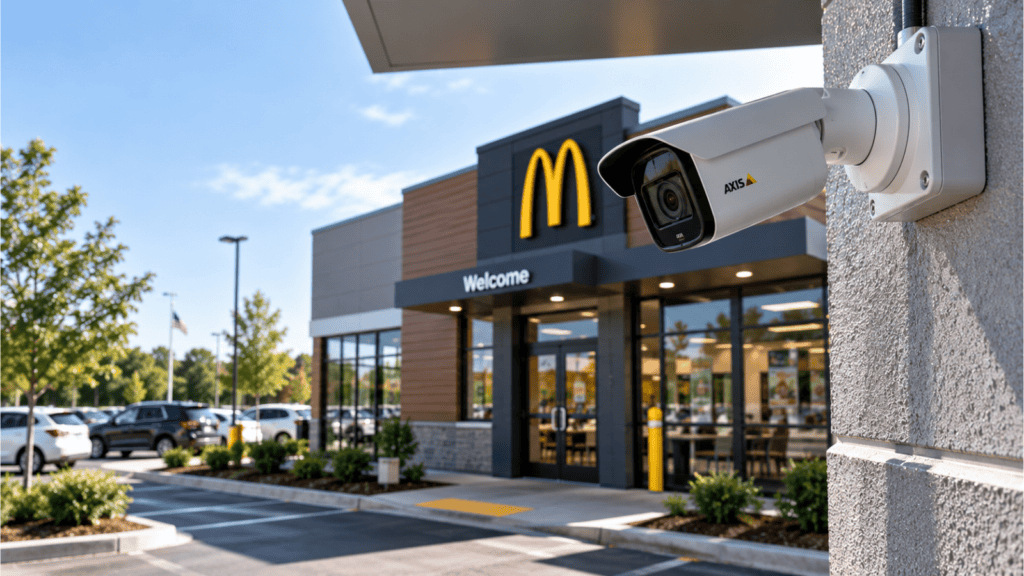
Security cameras are one of those purchases most restaurant operators make once, install, and then do not think about again until something goes wrong. That approach made more sense when a camera system was just a recorder and a few fixed lenses pointed at the parking lot. It makes less sense now, when the system is expected to retain footage for 60 to 90 days, integrate with POS data for loss prevention, cover 16 specific zones for franchise compliance, and perform reliably through years of daily operation without meaningful maintenance.
This guide covers what QSR and commercial operators should actually evaluate when choosing a camera system, what the NRBES 2027 mandate requires for McDonald's franchisees, and what questions to ask before signing with a provider.
What a Commercial Camera System Actually Consists Of
IP cameras
IP cameras are the current standard for commercial QSR installation. IP cameras transmit video over Cat5 or Cat6 structured cabling using Power over Ethernet, which means a single cable run handles both power and data. They produce higher resolution footage than analog cameras, support remote access, and are what the McDonald's NRBES 2027 mandate requires. If your current system uses analog cameras running on coaxial cable, it cannot be upgraded to meet the NRBES standard. It needs to be replaced.
The NVR
The NVR — Network Video Recorder — is the device that stores footage from IP cameras. NVR configuration determines how many days of footage the system retains before it begins overwriting. For McDonald's franchisees, the NRBES 2027 standard requires 90 days of retention on the office camera and 60 days on all other cameras. A system installed with default NVR settings almost never meets those requirements out of the box. Retention settings need to be configured and verified at installation, and checked periodically to confirm storage is not filling faster than expected.
Structured cabling infrastructure
Structured cabling is what connects the cameras to the NVR. IP cameras require Cat5 or Cat6 PoE cabling runs to every camera location. If a location was previously running analog cameras, there is likely no IP-compatible cabling in the walls. Every camera zone needs a new cabling run. For a typical QSR location, that is a meaningful portion of the total installation cost and the part that takes the most time.
The camera placement plan
The camera placement plan determines what the system actually covers. A camera that is correctly specified but poorly positioned creates a blind spot. Blind spots in loss prevention, franchise compliance zone coverage, and incident documentation are invisible until they matter — at which point they matter significantly.
What NRBES 2027 Requires
For McDonald's franchisees, the camera system decision is not optional. McDonald's NRBES 2027 mandate requires all restaurants to migrate from analog to IP-CCTV by January 1, 2027. The requirement covers 16 specific camera zones:
Parking lot, pull forward area, curbside, vehicle license plate capture, lobby, lobby entrance, PlayPlace where applicable, front counter, cash booth, presenter's booth, office, back door, side door, trash corral, crew room, and freezer.
A system that covers some of these zones but not others is not compliant, regardless of camera quality. A system that meets zone coverage requirements but does not meet the storage retention specifications is also not compliant. The compliance assessment needs to evaluate both.
The NRBES 2027 deadline is also a franchise standing issue, not just a technical requirement. A flagged NRBES violation affects the Reinvestment National Franchising Standard assessment and a franchisee's standing with their Franchise Business Partner. The correction window of 30 to 90 days after a violation is flagged is not a safety net — it is a period during which that standing is already affected.
For multi-unit McDonald's operators, the math on the January 2027 deadline is straightforward. A full compliance installation covers 2 to 3 days per location. For an operator with 10 locations, that is 20 to 30 installation days that need to be scheduled, sequenced, and executed without disrupting daily service. Installation capacity among OTP-certified providers is finite and is tightening as the deadline approaches. Operators who act in Q3 2026 have scheduling flexibility. Operators who wait until Q4 will be competing for limited capacity with every other franchisee who also waited.
What to Evaluate Beyond the Camera Spec
IR night vision performance
IR night vision performance is one of the most common hidden weaknesses in installed camera systems. IR clarity degrades over years of use. A camera that produced a clear image of the back door at installation may produce footage too dark to identify a face three years later. This degradation happens gradually and invisibly — the camera appears to be recording, the system shows no errors, and the problem only becomes visible when the footage is needed for an incident review.
NVR storage management
NVR storage management is the other common hidden problem. Storage fills over time. If nobody is monitoring how much storage remains and adjusting retention settings accordingly, a system can begin overwriting footage before the required retention period without triggering any alert. The operator believes they have 60 days of footage. They have 22.
Camera placement vs. camera count
Camera placement is a judgment call that requires knowing the specific layout of each location. More cameras in the wrong positions provide less coverage than fewer cameras placed correctly. A provider who sends you a spec sheet without walking your location is not giving you an accurate assessment.
Solink integration
Solink integration is worth asking about specifically for QSR operators running exception reporting against POS data. Solink connects POS transaction data to camera footage so that a flagged transaction — a void, a refund, a no-sale — can be reviewed in seconds without manually searching through hours of recording. For multi-unit operators managing loss prevention across several locations, Solink integration is the difference between an exception report that gets reviewed and one that sits in a folder. CGS is a Solink partner.
Questions to Ask Before Choosing a Provider
- Are you OTP-certified for McDonald's installations? If you are a McDonald's franchisee, your camera installation provider needs to be McDonald's OTP-certified. CGS is. A non-certified provider cannot guarantee that an installation meets NRBES specifications.
- Will you walk each location before quoting? A remote quote based on square footage or a floor plan is not an accurate assessment.
- What are the NVR retention settings at installation, and how are they verified? The answer should be specific. Default settings are not acceptable for a franchise compliance installation.
- What does the maintenance relationship look like after installation? Ask what the provider's service model looks like after the installation is complete, and whether they offer a proactive maintenance schedule or only respond to service calls.
- Do you handle the cabling? A provider who installs cameras but subcontracts the cabling has split accountability. When a camera goes offline and the question is whether the issue is the camera or the cabling, a provider who owns both can answer that question immediately.
How CGS Approaches Commercial Camera Installations
CGS installs and manages commercial CCTV for QSR operators across Georgia, South Carolina, and Ohio. We manage more than 12,000 active cameras across our service network. We are a McDonald's OTP-certified provider completing NRBES 2027 compliance installations across our service territory, and a Solink partner for POS-integrated video analytics.
Every CGS camera installation includes a site assessment before the quote, NVR configuration to verified retention specifications, structured cabling installation where needed, and post-installation documentation. For McDonald's franchisees, every installation is documented against the 16 NRBES zone requirements.
If you have not started your NRBES 2027 compliance assessment, or if your current camera system has not been assessed by a technician recently, contact us. We will tell you exactly what you have, what it is doing, and what needs to change.
Haven't Started Your NRBES 2027 Assessment? The Q4 Calendar Is Filling.
CGS is a McDonald's OTP-certified provider and Solink partner completing NRBES 2027 compliance installations across Georgia, South Carolina, and Ohio. We manage more than 12,000 active cameras across our service network. Every installation includes a site assessment, verified NVR retention settings, and post-installation documentation against all 16 NRBES zone requirements.
Schedule Your Free Site Assessment
About the Author
Written by Grant Wycliff, President of CGS. Grant works with McDonald's franchisees and QSR operators across Georgia, South Carolina, and Ohio on commercial security camera installations, NRBES 2027 compliance, and OTP-certified technology service. CGS manages more than 12,000 active cameras across its service network and is a McDonald's OTP-approved technology partner and Solink partner. Connect with us on LinkedIn.