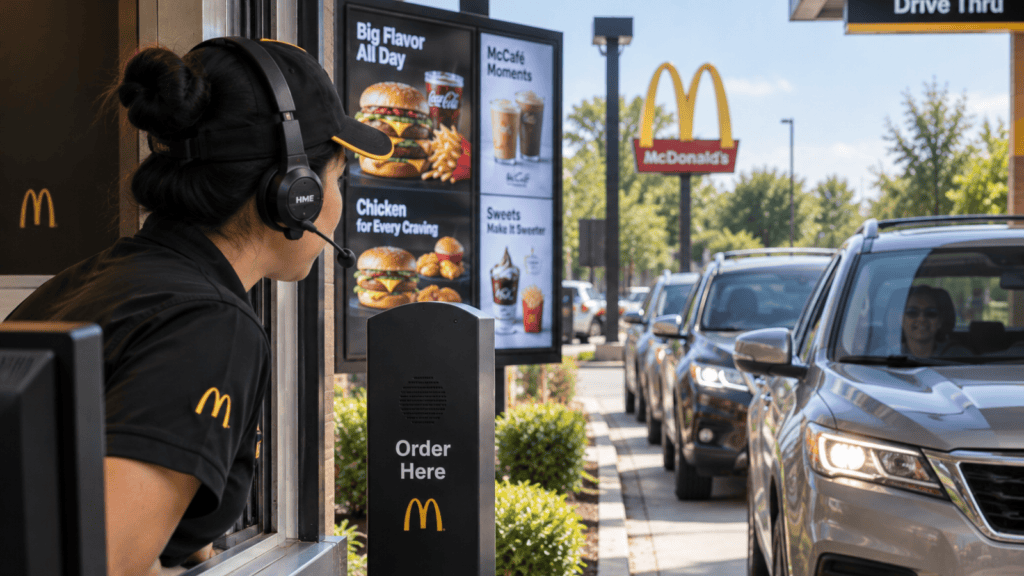
Drive-thru has been part of the QSR model for decades. But somewhere between the pandemic-driven volume surge and the current push for digital ordering, curbside, and mobile integration, the drive-thru stopped being a convenience feature and became the primary revenue channel for most quick-service restaurants.
At McDonald's, the drive-thru accounts for the majority of transactions. At most QSR chains, the number is similar. For a single-location operator, the drive-thru lane is where the business lives or dies on any given lunch shift. For a multi-unit operator, it is the variable that explains most of the performance gap between the best and worst locations in the portfolio.
That makes the technology running it more consequential than most operators treat it.
What Is Actually Happening in the Lane
A modern drive-thru is not a speaker post and a window. It is a stack of integrated systems: the communication system that connects the customer to the crew, the timer that measures every transaction against a performance standard, the order confirmation board that reduces errors before the car reaches the window, the surveillance cameras covering the lane and the presenter's booth, and the network infrastructure keeping all of it online simultaneously.
Each of those systems has a vendor. Each has a service model. Each degrades over time in its own way and on its own schedule. And when one of them underperforms — when the headset audio drops, when the timer loses accuracy, when the confirmation board goes dark — the crew adapts. They raise their voices. They mentally track orders. They work around it. And throughput suffers in ways that are almost impossible to see from a report.
A 30-second slowdown in average transaction time can cost a single location roughly $32,000 per year in lost revenue. That number is not from a broken system. It is from a system that nobody has looked at in a while.
The Hidden Cost of Reactive Maintenance
Most QSR operators run their drive-thru technology reactively. The system gets installed, commissioning gets signed off, and then nothing happens until something breaks loudly enough that someone calls in a service request.
The problem is that drive-thru systems do not fail dramatically. They degrade. Speaker sensitivity drifts. Headset batteries lose capacity over 12 to 18 months of daily charge cycles. Audio clarity drops gradually, imperceptibly, until the crew is asking customers to repeat themselves on every third order. The system still works. Nobody calls it in. The performance loss compounds quietly across every shift.
The operators who avoid this are not doing anything sophisticated. They have a service relationship with a provider who looks at the system on a schedule rather than waiting for a failure report. A technician who visits a location twice a year will catch a drifting speaker calibration, a battery that is holding 60 percent of its original capacity, and a headset that is performing below spec before any of those problems affects a transaction. A technician who shows up only when called finds the same problems after they have already cost something.
Why Multi-Unit Operators Face a Different Problem
For a single-location operator, the drive-thru technology challenge is maintenance. For a multi-unit operator, it is consistency.
When five or ten locations are running different equipment generations, different headset configurations, and different service histories, performance variance across the portfolio is structurally guaranteed. The best location and the worst location have the same training program and the same staffing model. The gap between them is almost always in the technology.
The operators who scale well standardize early. The same communication system platform at every location, configured the same way. The same timer setup. The same camera coverage. The same maintenance program. When something fails, the fix is already known because the same system has been serviced the same way somewhere else. When a manager moves between locations, the equipment is familiar and the crew does not need to relearn the tools.
Standardization is not about locking in any particular manufacturer. It is about being able to manage the full portfolio as a system rather than as a collection of independent problems.
What Opening Day Actually Requires
New store builds are where drive-thru technology problems get baked in most durably. The construction timeline is compressed. The technology installation gets sequenced around the general contractor's schedule. Drive-thru cabling needs to go in before the parking lot is poured, but the technology vendor is often the last contractor on site. When the schedule slips, the installation gets compressed. Commissioning gets shortened. And the restaurant opens with a drive-thru system that was installed in a hurry and never fully tested under operating conditions.
The problems from that scenario show up on opening day. Static in the headsets that nobody caught during the walkthrough. A timer integration that is not reflecting actual order status. Speaker calibration that was set for a quiet building and underperforms in a lane with a car engine idling in front of it.
The way to prevent this is to have a technology partner who understands construction sequencing and owns the full stack — cabling, communication system, cameras, network, and timer — rather than a series of vendors who each install their piece and leave. One partner means one point of accountability when something is not working during commissioning. It also means someone who can work with the general contractor to get cabling in before the walls close and conduit in before the ceiling finishes, rather than trying to retrofit infrastructure after the building is done.
The Technology Behind the Window
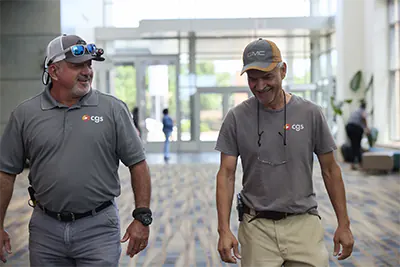
CGS has been installing and maintaining drive-thru systems for QSR operators across Georgia, South Carolina, and Ohio for more than 35 years. We are HME and PAR certified, with OTP Pro certified technicians on staff and a 97% first-trip resolution rate across more than 500 drive-thru maintenance customers.
We handle the full technology stack: communication systems, timer systems, order confirmation and pre-sell boards, drive-thru surveillance cameras, structured cabling, and the network infrastructure that keeps everything online. For multi-unit operators, we build the same system configuration at every location so performance is consistent and management overhead is predictable.
When Did Your Drive-Thru Last Get a Professional Assessment?
CGS has been installing and maintaining drive-thru systems for QSR operators across Georgia, South Carolina, and Ohio for more than 35 years. We are HME and PAR certified, with OTP Pro certified technicians on staff and a 97% first-trip resolution rate across more than 500 drive-thru maintenance customers. Contact us for a drive-thru assessment — we will tell you exactly what you have and what it is costing you.
Request a Drive-Thru Assessment
About the Author
Written by Grant Wycliff, President of CGS. Grant works with QSR franchise operators and multi-unit operators across Georgia, South Carolina, and Ohio on drive-thru systems, full-stack technology installation, and OTP-certified service. CGS is a McDonald's OTP-approved technology partner and HME and PAR certified installer with more than 35 years serving the QSR industry. Connect with us on LinkedIn.