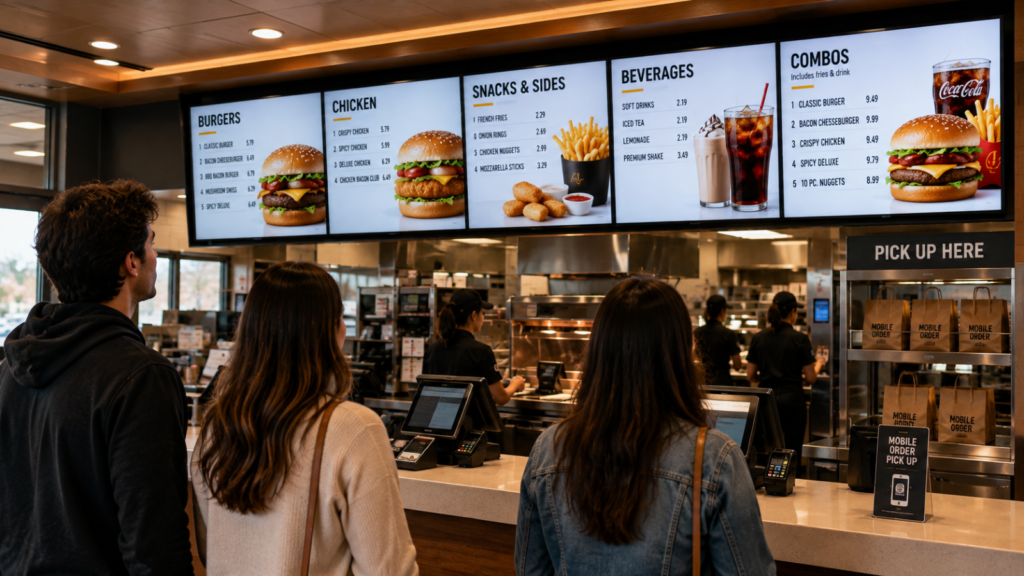
Most conversations about digital menu board upgrades start in the wrong place. They start with the display, resolution, brightness, size, how it looks on the wall. Those things matter, but they are not why the investment pays off.
The operators who get the most out of digital menu boards are not the ones with the best-looking screens. They are the ones who figured out that a digital menu board is not a display. It is a control system for how customers interact with their menu, and the value it creates is almost entirely operational.
What Static Menu Boards Actually Cost
A static menu board has a price that is easy to see: the cost to design and print it, and the cost to swap it when something changes. What is harder to see is the cost of everything you did not do because the menu board was static.
You did not run a breakfast promotion because the board was showing the all-day menu and you did not want to pay for a print swap. You did not update the pricing on three items when your costs changed because it was not worth pulling the whole board. You did not test whether featuring a higher-margin item in a prominent position would shift the order mix, because testing anything on a static board means reprinting it.
Every one of those decisions has a revenue consequence that never shows up anywhere because the counterfactual is invisible. The promotion that did not run, the pricing that did not adjust, the upsell that never got tested, these are the costs of a static menu board, and they are significantly larger than the cost of the prints.
Dayparting
The single most immediate revenue impact of a digital menu board for most QSR operators is the ability to daypart without friction. A breakfast menu that switches to a lunch menu at 10:30 without anyone touching anything. A late-night menu that activates at 10pm. A limited-time offer that runs during specific hours and then disappears.
Most QSR operators already know what their best-performing daypart looks like. Digital menu boards let them engineer the menu presentation to match it, featuring the items with the highest margin and the strongest pull during the windows where they are most relevant. That is a meaningful revenue optimization that is not available on a static board.
Price and Promotion Agility
A commodity price spike changes what a QSR operator can afford to charge for a specific item. With a static board, the response to that change involves a design and print cycle that takes days or weeks. During that time the operator is either absorbing the margin hit or running a price that the board does not reflect.
With a digital board connected to a content management system, a price change takes minutes. A promotion can be activated for a specific window on a specific day and turned off when it is over. A test of whether a featured item drives higher attachment rates on a specific drink can be run and evaluated in a week without reprinting anything.
Multi-Location Consistency
For franchise operators running multiple locations, the menu board is a compliance and brand consistency problem as much as a revenue tool. A price that is different at location 3 than location 7 because someone did not execute the print swap correctly. A promotional item that is still featured at two locations after the promotion ended because the board has not been updated. A grand opening special that ran indefinitely because nobody tracked which locations had which version of the board.
A digital menu board system connected to a central content management platform means one update reaches every location simultaneously. The person who controls the content management system does not have to call each location and confirm the board was changed. It changed. The record is in the system.
The Drive-Thru Specific Case
Drive-thru digital menu boards have one additional variable that indoor boards do not: readability in direct sunlight. A display that is easy to read inside a climate-controlled lobby is not necessarily readable from a car window at noon in July in Georgia or South Carolina.
Commercial-grade outdoor drive-thru displays are rated for daylight readability at brightness levels that consumer displays cannot sustain. They are also rated for the temperature range that a South Carolina or Ohio summer and winter creates. The display that was an attractive price on a commercial AV website but was not specified for outdoor installation will fail within a season.
The hardware choice for a drive-thru display is a decision that lasts years. Choosing hardware that cannot sustain outdoor operating conditions is a decision that has to be undone, at full cost, before it would otherwise need to be replaced.
What to Ask Before Buying Hardware
Before committing to a digital menu board system, four questions are worth asking: Does the content management system allow dayparting and scheduled promotions, or does content have to be changed manually? Can the system manage multiple locations from a single dashboard, and is that included in the licensing or an add-on? For outdoor displays, what is the specified brightness in nits and what operating temperature range is it rated for? Who handles installation, content management support, and hardware maintenance, the hardware manufacturer, a local AV company, or a national chain that will send a technician from three states away?
The answers to those questions determine whether you are buying a display or a revenue tool. The hardware is the visible part. The content management system, the installation quality, and the ongoing support relationship are what determine whether the investment pays off.
CGS Installs and Manages Digital Menu Boards
CGS installs commercial-grade digital menu board systems for QSR operators and restaurants across Georgia, South Carolina, and Ohio. We work with Mood Media's digital signage CMS for content management, handle the hardware installation, and support the system ongoing. If you are evaluating a digital menu board upgrade, contact us for a free assessment of what your operation needs.
Frequently Asked Questions
How much do commercial digital menu boards cost?
The range is wide and depends on the number of displays, indoor versus outdoor installation, and the content management system. A single indoor replacement can run from $2,000 to $5,000 installed. A full drive-thru outdoor configuration with multiple panels runs higher. A free system review gives you a number for your specific location.
Can I keep my existing screens and just add a content management system?
Sometimes. It depends on the age and specifications of the existing displays, whether they have the connectivity required for a digital signage player, and whether they meet the brightness and operating temperature requirements for their location. CGS assesses this during the free system review.
How difficult is it to update content once the system is installed?
With a properly configured CMS, basic content updates, price changes, promotional items, daypart menus, take minutes and do not require technical knowledge. CGS trains operators on the system during installation and provides ongoing support.
Evaluating a Digital Menu Board Upgrade? Start With a Free Assessment.
CGS installs commercial-grade digital menu board systems for QSR operators and restaurants across Georgia, South Carolina, and Ohio. We work with Mood Media's digital signage CMS for content management, handle the hardware installation, and support the system ongoing. Contact us for a free assessment of what your operation needs. Call or text 1-800-277-9444 or visit cgsvideo.com.
Get a Free System Assessment
About the Author
Written by Grant Wycliff, resident of CGS. Grant works with QSR operators and restaurant owners across Georgia, South Carolina, and Ohio on digital menu board installations, commercial AV, and full-stack technology integration. CGS installs and maintains commercial-grade digital menu board systems using Mood Media's CMS platform for operators across the region. Connect with us on LinkedIn.