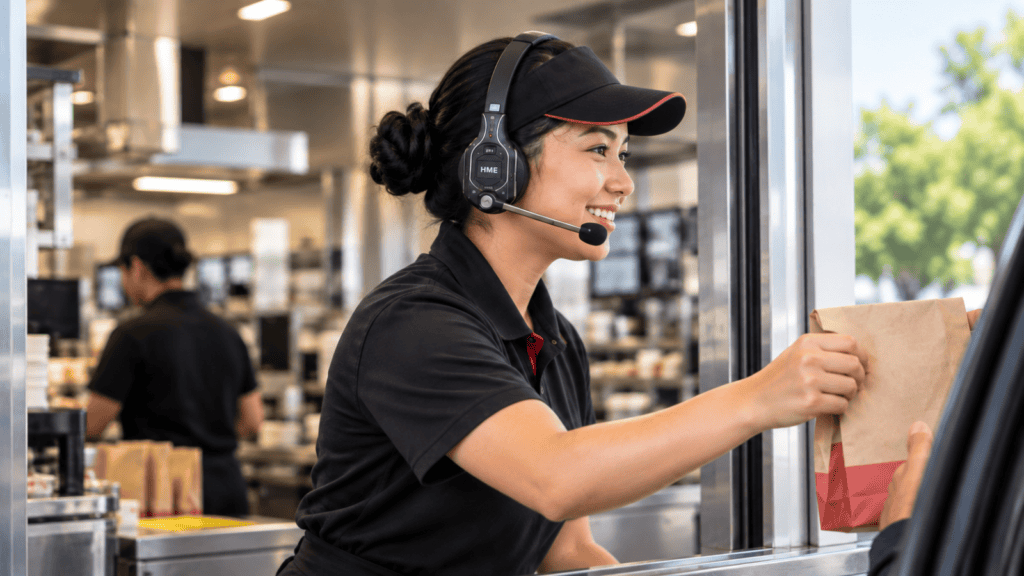
The drive-thru headset is the piece of equipment that every customer interacts with and almost no one outside the building ever thinks about. The crew wears it all shift. The customer speaks into a speaker post connected to it. Every order that comes through the lane starts with a conversation that either goes clearly or does not.
For a QSR operator buying a headset system for the first time, or replacing one that has run past its useful life, the options are more varied than they used to be. This guide covers what the system actually consists of, what separates the HME and PAR platforms that most commercial QSR operators use, and what to think about beyond the hardware itself.
What a Drive-Thru Headset System Actually Consists Of
A drive-thru communication system is not a single device. It is a set of components that work together, and the quality of the experience depends on all of them performing at spec simultaneously.
The headsets
Commercial QSR headsets are worn over one or both ears, include a microphone on an adjustable boom, and connect wirelessly to the base station. In a high-volume environment, comfort matters as much as audio quality — a crew member wearing a headset for a six-hour shift will notice weight, ear pressure, and battery life in ways a brief demo never reveals.
The base station
The base station is the hub that manages all connected headsets. It controls which channels are active, how many headsets can communicate simultaneously, and how the system handles multiple conversations in a multi-lane environment. A base station that is not configured correctly for a two-lane operation is one of the most common sources of communication confusion in a busy drive-thru.
The speaker post
The speaker post is the outdoor unit where the customer places the order. Speaker post performance is affected by placement, angle, road noise, weather exposure, and calibration. A speaker post that sounded fine during installation and has never been re-calibrated is almost certainly performing below its original specification. Wind, temperature swings, and years of daily use all affect audio clarity at the order point.
The order confirmation board
The order confirmation board is the display screen that shows the customer what was entered before they pull forward. It reduces order errors and gives the crew a moment to correct mistakes before the car reaches the window. For operators running at high volume, a confirmation board is not optional equipment.
The lane sensor
The lane sensor detects vehicles entering the drive-thru lane and triggers the system to alert the crew. In a timer-integrated setup, the lane sensor is also where the clock starts. A sensor that is misaligned, degraded, or set with the wrong sensitivity creates timer data that does not reflect reality.
The timer system
The timer system connects to the lane sensor and tracks every car through the drive-thru from detection to departure. Timer data is how operators identify performance gaps, compare locations, and benchmark improvement. A timer that is not integrated with the headset system, or that is receiving bad data from a degraded sensor, is measuring the wrong thing.
HME and PAR: The Two Commercial Platforms
Most commercial QSR operators in the US are running one of two headset platforms: HME or PAR. Both are purpose-built for the demands of a commercial drive-thru environment in ways that consumer or light commercial audio equipment is not.
HME — Headset Microphone Electronics — has been the dominant platform in QSR drive-thru communication for decades. The HME NEXEO system is the current-generation platform, and it is what most major QSR chains, including McDonald's, have specified or approved for their locations. NEXEO is a digital system with cloud-connected management, multi-lane capability, and integration with kitchen display and timer systems.
PAR — originally Panasonic, now PAR Technology following acquisition — is the other major platform in the commercial QSR space. PAR systems are widely used across the QSR industry and are fully supported by certified technicians in the commercial drive-thru service market.
Both platforms require trained, certified technicians for installation, commissioning, and service. The certification matters because drive-thru headset systems are not plug-and-play equipment. Speaker post placement, sensitivity calibration, base station channel configuration, and headset pairing all require technical expertise to set correctly. A system installed by a technician without manufacturer certification is very likely operating below its design performance from day one.
CGS carries HME and PAR certification. Our technicians are trained on both platforms, which means we can work with the system a location already has, commission a new installation correctly, and service the equipment on a schedule that prevents the gradual performance degradation that most operators never notice until it has already cost them.
What to Think About Beyond the Hardware
The hardware decision matters. The service decision matters more.
A drive-thru headset system that was installed correctly and commissioned properly will still degrade over time if it is not maintained. Headset batteries lose capacity over 12 to 18 months of daily charge cycles. Speaker posts drift. Base station settings get changed during a troubleshooting call and never returned to optimal configuration. None of this is dramatic. None of it triggers a service call. It all shows up as gradually slower transactions and slightly less accurate orders, adding seconds to every car through the lane until the cumulative loss becomes visible in throughput data.
The question worth asking before choosing a headset system is not just what equipment to buy. It is who will service it, on what schedule, and what happens when something stops working at noon on a Friday.
What Consistent Performance Looks Like
The operators who run the tightest drive-thru operations share a few consistent habits around their headset systems.
They know what is installed at every location and when it was last serviced. They have a baseline for what normal performance looks like at each site, so a degradation is visible before it becomes a failure. They have a service relationship with a certified partner who checks the system on a schedule, not just after a crew member reports a problem.
For multi-unit operators, they run the same headset platform at every location. When something fails, the fix is already known because the same system has been repaired somewhere else. When a manager transfers between locations, the equipment is familiar and the crew does not need to adapt.
Standardization is not about limiting options. It is about being able to manage a portfolio of locations as a system rather than as a collection of independent problems.
How CGS Approaches Drive-Thru Headset Installation and Service
CGS is an HME and PAR certified provider serving QSR operators across Georgia, South Carolina, and Ohio. We install and maintain drive-thru communication systems as part of a full technology stack that includes speaker posts, timer systems, order confirmation boards, lane sensors, surveillance cameras, and the network infrastructure that keeps everything running.
For new store builds and remodels, we coordinate with the general contractor to ensure drive-thru cabling is in place before the parking lot is poured and speaker post conduit is run before the lot is finished. Trying to retrofit drive-thru infrastructure after construction is complete is one of the most common and most avoidable sources of opening day technology problems.
For existing locations, we offer drive-thru system assessments that tell you exactly what you have, what is performing at specification, and what has degraded to the point where it is affecting throughput. Most operators who go through an assessment for the first time find at least one issue they did not know existed.
Our 97% first-trip resolution rate across more than 500 drive-thru maintenance customers means that when we do come out, we fix it the first time.
If you operate QSR locations across the Southeast or Midwest and want to know whether your headset system is performing at the level it was designed for, contact us. We are happy to start with an assessment before any conversation about new equipment.
Not Sure If Your Headset System Is Performing at Spec? Find Out.
CGS is an HME and PAR certified provider serving QSR operators across Georgia, South Carolina, and Ohio. We install, commission, and maintain drive-thru communication systems as part of a full technology stack. If your headset system has not been assessed by a certified technician recently, contact us. We will tell you exactly what you have and what it is costing you.
Request a Headset Assessment
About the Author
Written by Grant Wycliff, President of CGS. Grant works with QSR operators across Georgia, South Carolina, and Ohio on drive-thru headset systems, HME and PAR installations, and full-stack technology service. CGS is an HME and PAR certified provider with a 97% first-trip resolution rate across more than 500 drive-thru maintenance customers. Connect with us on LinkedIn.