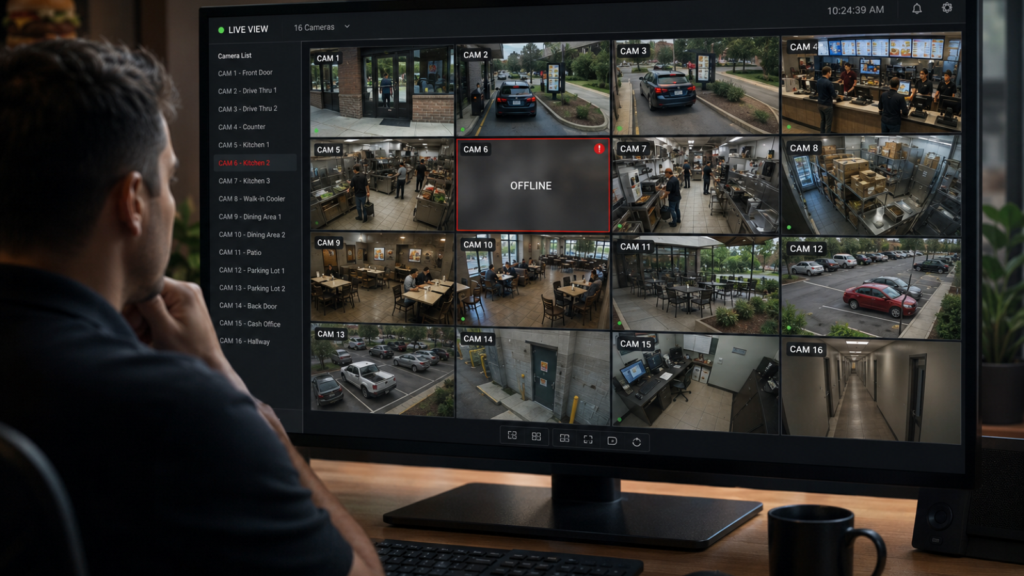
Most restaurant operators can tell you exactly when their fryers were last serviced, when their POS system was last updated, and when their drive-thru headsets were last replaced. Ask the same operators when their security camera system was last assessed and most of them cannot answer.
Camera systems tend to get installed and forgotten. They record. Nothing is obviously wrong. Life moves on.
The problem is that nothing is obviously wrong right up until something very obviously is.
How Camera Systems Actually Degrade
Security camera systems do not fail dramatically. They degrade gradually, in ways that are easy to miss if nobody is actively looking.
IR night vision clarity drops over months as camera components age. A camera that showed a clear image of your back door two years ago may now produce footage that is too dark to identify a face at night. NVR storage fills silently and begins overwriting footage before the retention period your insurance or franchise agreement requires. A camera shifts its field of view slightly, creating a blind spot in a coverage zone that nobody notices until that zone matters.
None of these failures announce themselves. They accumulate quietly while the system continues to appear operational.
What the Installation Process Actually Involves
This is where most franchisees underestimate the scope. Moving from analog to IP-CCTV is not a camera swap. Most locations that were previously running analog systems need new cabling runs to every required zone, because IP cameras require Cat5 or Cat6 PoE infrastructure that analog systems do not have.
A full compliance installation covers:
- Site assessment and audit of the current system against NRBES zone requirements
- Removal of existing analog cameras and cabling
- Structured cabling installation to all required zones
- IP camera installation at each zone
- NVR configuration with correct retention settings
- Post-installation verification and documentation
For a single location, CGS completes most NRBES compliance installations in 2 to 3 days. For a multi-unit operator, the math is straightforward: 10 locations is potentially 20 to 30 installation days that need to be scheduled, sequenced, and executed without disrupting daily service.
What You Actually Need Your Camera System to Do
A security camera system serves several functions that operators tend to only think about after one of them fails.
Loss prevention is the obvious one. A functioning camera system deters theft, documents incidents, and gives managers the ability to review footage when something does not add up at the register or in inventory. For QSR operators using tools like Solink that link POS transactions to camera footage, a degraded camera covering a key terminal creates a blind spot in exception reporting that a theft investigation will find at exactly the wrong moment.
Franchise compliance is the less obvious but equally important one. McDonald's NRBES 2027 requires specific zone coverage and storage retention across all locations. An aging system that does not meet those specifications is a compliance liability regardless of whether the cameras appear to be recording.
Insurance and liability documentation is the third function. When a slip and fall incident or a customer dispute requires footage review, a system that was overwriting footage after 30 days instead of 60 creates a documentation gap that is expensive to explain.
The Analog to IP Migration Question
For many QSR operators, particularly McDonald's franchisees, the camera system assessment question is also a compliance question. McDonald's NRBES 2027 mandate requires all locations to migrate from analog to IP-CCTV by January 1, 2027.
If your camera system is more than 5 to 7 years old, there is a good chance it is running on analog infrastructure. That infrastructure cannot be upgraded to meet the NRBES standard. It needs to be replaced.
The operators handling this intelligently are not treating the NRBES mandate as an isolated compliance project. They are treating it as an opportunity to assess the full state of their camera systems across all locations, identify what needs to be replaced, and build an installation plan that addresses compliance and performance together rather than separately.
Signs Your Camera System Needs Attention
You do not need a formal audit to identify obvious warning signs. Here are the ones worth acting on immediately.
- Footage from any camera is noticeably darker, grainier, or lower resolution than it was when the system was installed
- Any camera has shifted its field of view and is no longer covering the zone it was installed to cover
- Your NVR storage settings have never been reviewed since installation
- You cannot confirm how many days of footage your system is currently retaining
- You have had any camera offline for more than a week without a service call
- You cannot remember the last time a technician looked at the system
If any of those apply, the right first step is a system assessment, not a full replacement conversation. An assessment tells you what the system currently looks like, what is performing, what is degrading, and what needs to be addressed. It is the difference between making an informed decision and guessing.
What Proactive Camera Management Actually Looks Like
The operators who consistently avoid camera system problems are not doing anything complicated. They know what their system is supposed to cover. They have confirmed their retention settings meet their compliance and insurance requirements. They have a service relationship with a provider who checks the system on a schedule, not just when something breaks.
That last point matters more than most operators realize. A technician who visits a location twice a year will catch IR clarity degradation, storage management issues, and coverage gaps before they become incidents. A technician who only shows up when called will find out about those problems after they have already cost something.
CGS maintains 12,000+ active CCTV cameras across our service footprint in Georgia, South Carolina, and Ohio. We have OTP Pro certified technicians on staff and handle everything from routine maintenance to full IP-CCTV compliance installations. If you have not had your camera system assessed recently, or if you are a McDonald's franchisee who has not started your NRBES 2027 compliance process, contact us. We can tell you exactly what you have and what you need.
Learn More About CGS's Camera System Services
CGS offers a Camera System Assessment for QSR operators who want to know whether their current setup is meeting compliance, retention, and coverage requirements. If you haven't had your system reviewed recently — or if you're a McDonald's franchisee working toward NRBES 2027 compliance — we're happy to walk through what our approach looks like in practice.
Schedule Your Assessment
About the Author
Written by Grant Wycliff, President of CGS. Grant has spent years working alongside restaurant operators who discovered their camera systems were underperforming only after an incident made it impossible to ignore. That experience shapes how CGS approaches security camera work — proactive assessments, scheduled maintenance, and compliance installations that are done right before deadlines and liability force the issue. Under Grant's leadership, CGS now maintains 12,000+ active CCTV cameras across the Southeast, with OTP Pro certified technicians handling everything from routine checkups to full IP-CCTV upgrades. Connect with us on LinkedIn.