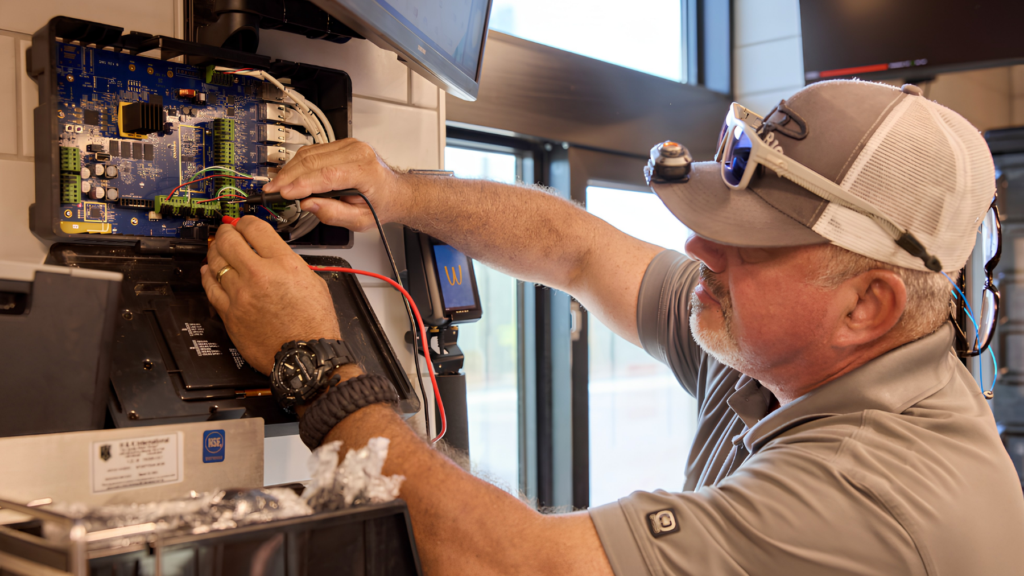
CGS has worked with McDonald’s operators across the Southeast and Mid-Atlantic — and the pattern we see most often isn’t operators who made a bad decision. It’s operators who made a reasonable decision that looked fine at installation and revealed itself as the wrong choice six to eighteen months later.
Selecting an OTP provider doesn’t feel like a high-stakes decision in the moment. You look at approved providers, compare availability and price, and move forward. On paper, it’s procurement. In practice, it’s one of the most consequential operating decisions you’ll make — because that provider will shape how your stores perform every day.
Why This Decision is Harder Than It Looks
At installation, every OTP provider looks roughly the same. The system is in. It works. There are no obvious issues.
The differences emerge over time — in how issues are handled, how consistently systems perform, how quickly problems are identified and resolved. By the time those differences are visible, the provider is already embedded in your operation.
That’s what makes this decision worth more thought upfront than most operators give it.
The Common Mistake : Evaluating on the Wrong Criteria
Most operators evaluate OTP providers on:
- Availability in their market
All of those matter. None of them tell you how the provider will perform six months after installation.
They don’t tell you how quickly issues will be resolved, whether problems will be caught before they impact operations, or how consistent support will be across your locations.
The 4 Questions Most Operators Don't Ask (But Should)
When evaluating or re-evaluating an OTP partner, these are the questions that actually predict long-term performance — along with how CGS answers each one.
1. How Do You Handle Uptime — Not Just Repairs?
A vendor responds when something breaks. A performance partner is focused on preventing the break in the first place. Ask specifically how a provider ensures system performance during peak hours — not just what their repair response time is.
How CGS answers: We establish performance baselines for every location we support and monitor for drift. Our focus is on uptime, not just repair speed.
2. How Do You Identify Problems Before They Become Failures?
Most system degradation is gradual. Audio clarity drops over months. Display performance fades. Response times creep upward. A reactive provider doesn’t see these trends until they become service calls. A proactive partner catches them before they affect throughput.
How CGS answers: We look for early indicators of degradation — subtle shifts in audio performance, display consistency, system response — before they show up as obvious failures.
3. How Consistent Is Your Support Across Locations?
For multi-unit operators, consistency is everything. If one location gets excellent support and another gets average support, your operational performance will reflect that gap. Ask for specifics on how a provider ensures consistency at scale.
How CGS answers: CGS operates with standardized assessment and support protocols across all locations we serve. Operators with multiple stores can expect the same evaluation rigor and response standards regardless of location.
4. What Is Your Peak-Hour Response Time?
Average response time is a misleading metric. The question that matters is how quickly a provider responds when your drive-thru is at full volume and a system issue emerges. That’s when delays are most costly.
How CGS answers: We prioritize peak-hour escalations and structure our support coverage to reflect when operators actually need it most.
What Happens When the Wrong Partner Is In Place
The consequences are rarely dramatic. That’s part of what makes this problem so expensive.
- Performance becomes inconsistent across locations
- The same issues repeat instead of being resolved at the root cause
- The team compensates for system friction by working harder — increasing pressure without improving throughput
- Throughput slowly declines: not dramatically, but enough to affect cars per hour, revenue, and customer experience
Nothing is clearly broken. Everything still “works.” But it doesn’t perform the way it should — and that gap is the most expensive kind of problem, because it hides in plain sight.
When It's Time to Re-Evaluate Your Current Partner
If any of the following sound familiar, it’s worth taking a closer look:
- Your drive-thru feels slower, but nothing is clearly broken
- One location consistently outperforms another with the same team
- Issues seem to repeat instead of being resolved
- Peak hours feel harder than they should
- Your team is strong, but performance is inconsistent
Frequently Asked Questions
Can I switch OTP providers mid-contract?
This depends on the terms of your current agreement and your specific franchise situation. It’s worth reviewing your contract language around performance standards and termination clauses. In some cases, documented performance issues create grounds for renegotiation.
How long does it take to see improvement after switching OTP providers?
In most cases, operators begin to see measurable improvement within 60–90 days of a transition — particularly in locations where audio or display issues were the primary constraint. System-wide consistency improvements across multiple locations typically take 3–6 months.
What should I ask a potential OTP provider before signing?
Beyond the four questions above: ask for references from multi-unit operators in your market, ask specifically about their monitoring and proactive maintenance practices, and ask how they handle performance disputes. How a provider responds to those questions is as informative as the answers themselves.
Final Thought : The Right Partner Should Make Operations Easier, Not Harder
The right OTP partner doesn’t just install compliant systems. They make your operation feel more predictable, more consistent, and less stressful during peak hours.
If your current setup isn’t doing that, it’s not a minor inconvenience. It’s a performance issue worth addressing.
Evaluate Your Current OTP Setup
CGS offers an OTP Performance Evaluation designed to help operators understand whether their current technology environment is supporting or limiting performance — including drive-thru communication clarity, system responsiveness, menu board performance, and recurring inefficiencies.
Schedule Your Evaluation
About the Author
Written by the CGS team. CGS is a McDonald’s OTP-approved technology partner serving operators across the Southeast and Mid-Atlantic. With over a decade of experience in QSR technology installation and performance optimization, the CGS team works directly with multi-unit operators to identify and resolve the system-level issues that limit drive-thru throughput. Connect with us on LinkedIn.