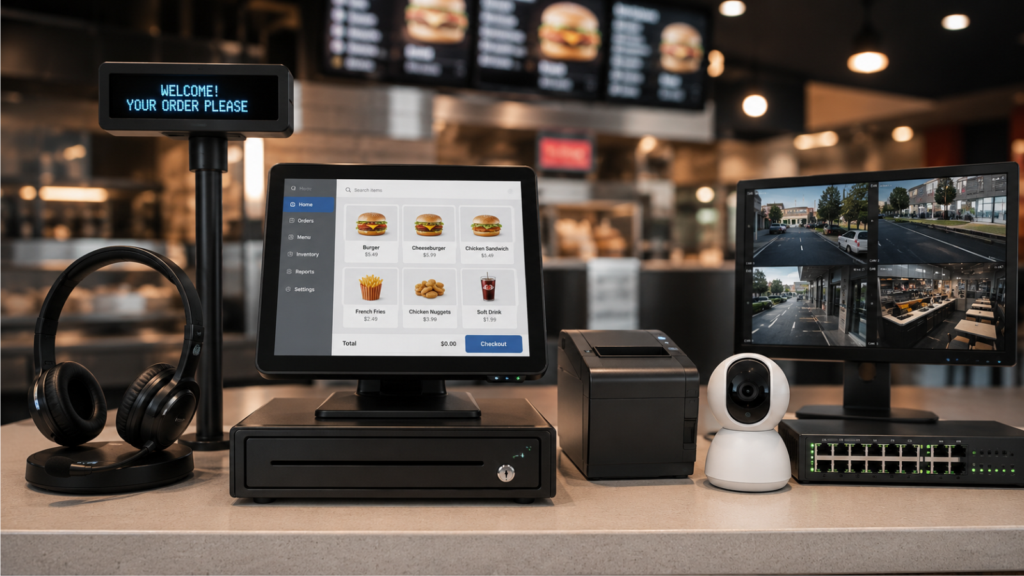
Ask a multi-unit QSR or retail operator what their biggest technology challenge is and most of them will say something about a specific system that is causing problems. The drive-thru headsets at location 4. The camera system at location 9 that keeps going offline. The network at the new build that has never been quite right.
The real answer, which most operators only articulate after thinking about it for a moment, is coordination. Not the systems themselves. The management overhead of keeping five or six vendor relationships running across 10 or 20 locations, each with different service histories, different equipment generations, and different points of contact.
That coordination cost is significant, and most operators have never actually calculated it.
What Technology Vendor Coordination Actually Costs
The direct costs are the obvious ones. Service call fees. Emergency repair costs when something fails during peak hours. Parts that get expedited because nobody was monitoring the system proactively. Travel time for technicians who come out, diagnose a problem, and have to come back with the right part.
The indirect costs are larger and harder to see.
Management time is the biggest one. Every service call requires someone at the operator level to make contact with the right vendor, explain the problem, coordinate access to the location, follow up when the technician does not show up on time, and verify the repair was actually completed. For a multi-unit operator with five vendors across 15 locations, that coordination load is a meaningful part of someone's job.
Performance inconsistency is the second indirect cost. When different locations have different equipment generations, different service histories, and different vendor relationships, performance varies. Your best location and your worst location have the same staffing model and the same training program. The gap between them is almost always in the technology. That gap shows up in throughput, in order accuracy, in customer experience, and ultimately in revenue. It is real money, and it is invisible in most reporting.
To put a number on that performance gap: according to a SeeLevel HX annual drive-thru study, a 30-second delay in drive-thru service costs a single location approximately $32,000 per year in lost revenue. If your worst-performing location is running with degraded audio, an aging headset system, or network infrastructure that has never been properly sized, that gap is not a staffing problem. It is a technology management problem.
Repeat service calls are the third indirect cost. A vendor who addresses symptoms rather than root causes creates a cycle where the same problem recurs at the same location every few months. Each call costs money. Each call requires management coordination. And the underlying problem never gets fixed because the vendor does not have visibility into the full technology stack and cannot see the cause.
The Consistency Gap Between Your Best and Worst Location
Multi-unit growth in the Quick Service Restaurant sector is accelerating. The International Franchise Association projected more than 12,000 new franchised businesses opening in 2026 in its latest Franchising Economic Outlook, with well-capitalized operators poised to acquire additional locations and expand market presence. Every new location added to a fragmented technology vendor model adds another layer of coordination complexity.
What distinguishes operators who scale well from those who struggle is not location count or budget. It is standardization. When every location runs the same drive-thru system configuration, the same network infrastructure, the same camera system setup, and the same maintenance program, troubleshooting becomes fast and predictable. A technician who knows exactly what is installed at every location can diagnose a problem in minutes rather than spending the first hour of a service call figuring out what they are dealing with.
When locations run different equipment generations because they were opened at different times with different vendors, a service call at location 12 requires starting from scratch every time. The technician does not know the system. The documentation does not exist. The repair takes longer, costs more, and is more likely to require a follow-up visit.
What High-Performing Multi-Unit Operators Do Differently
The operators who manage multi-unit technology rollouts well across multiple locations share a few consistent habits.
They treat technology standardization as an operational priority, not a procurement decision. The goal is not to find the cheapest vendor for each system category. It is to find a partner who can deploy and maintain a consistent configuration across every location so that performance is predictable and management overhead is low.
They demand proactive maintenance rather than reactive service. A vendor who monitors systems and addresses degradation before it causes failures is worth more than a vendor with a low hourly service rate who only shows up when called. The difference between proactive and reactive maintenance is the difference between a predictable operating cost and an unpredictable one.
They consolidate vendor relationships wherever possible. One partner covering drive-thru systems, cameras, network, and cabling across all locations means one service agreement and one team with visibility into the full technology stack. When something goes wrong, the question of who owns the problem has a clear answer.
They use performance data across locations to identify system problems before they affect revenue. If location 7 is running 15 seconds slower per car than location 3 with the same staffing model, the right question is not how to motivate the team at location 7. It is what is different about the technology. A partner with visibility across all locations can answer that question. A fragmented vendor model cannot.
The Calculation Worth Making
If you operate five or more locations, it is worth actually calculating what your current technology vendor model costs. Not just the service call invoices. The full picture: management time, repeat call frequency, performance variance between locations, and the revenue gap between your best and worst performers.
Most operators who do this calculation for the first time are surprised by the number. The service calls are visible. The management overhead and the performance variance are not. But they are real, and they compound across every location, every month.
CGS serves multi-unit operators across Georgia, South Carolina, and Ohio. We have OTP Pro certified technicians on staff and handle the full technology stack: drive-thru systems, CCTV, commercial WiFi, structured cabling, POS, and digital menu boards. One partner, consistent execution, and a single service agreement across every location. If your current technology vendor model is costing you more than you realize, contact us. We are happy to start with a conversation about what your operation currently looks like and where the gaps are.
Find Out What Your Technology Vendor Model Is Actually Costing You
CGS serves multi-unit QSR operators across Georgia, South Carolina, and Ohio with a single partner covering drive-thru systems, CCTV, commercial WiFi, structured cabling, POS, and digital menu boards. One service agreement, consistent execution across every location. Start with a conversation about what your current technology footprint looks like — and where the gaps are.
Talk to a Technology Partner
About the Author
Written by Grant Wycliff, President of CGS. Grant works with multi-unit QSR and retail operators across Georgia, South Carolina, and Ohio to consolidate technology vendor relationships and reduce the coordination overhead that comes with managing multiple locations. CGS is a McDonald's OTP-approved technology partner handling drive-thru systems, CCTV, commercial WiFi, structured cabling, POS, and digital menu boards. Connect with us on LinkedIn.