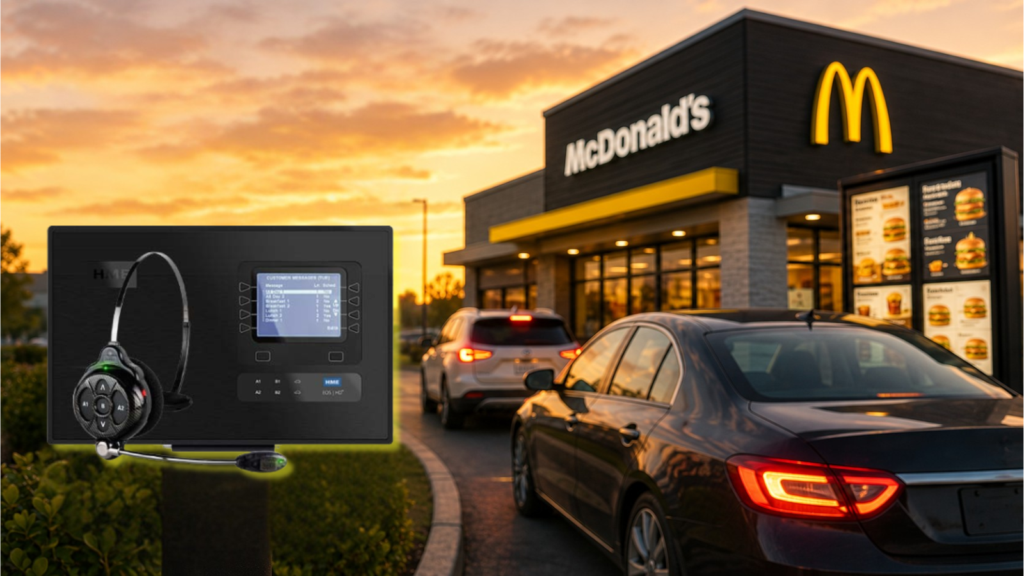
HME has ended EOS sales. If your locations are running EOS drive-thru systems, that fact changes your technology planning in ways that are worth thinking through clearly rather than reactively.
This post is not about urgency for its own sake. It is about understanding what the EOS parts and support timeline actually looks like so you can make a decision that serves your operation, not one you make when a system fails and your options have narrowed.
What End of Sale Actually Means
End of sale means HME is no longer selling new EOS systems. It does not mean your existing EOS system stops working tomorrow. EOS systems in the field will continue to operate and HME continues to provide parts and support for 10 years from the date equipment is formally obsoleted, so existing EOS systems in the field have a long runway.
What it does mean is that parts availability will narrow over time. As the installed EOS base transitions to NEXEO, manufacturing and stocking priorities shift. The parts that are readily available today may take longer to source in two or three years. The technicians who are most familiar with EOS configurations will increasingly be working on NEXEO systems.
This is the normal lifecycle of any commercial technology platform. The question is whether you plan your transition or react to it.
The Cost of Reactive Upgrades
There is a meaningful cost difference between upgrading on your own timeline and upgrading when you have to.
An operator who plans the EOS-to-NEXEO transition works with a certified local installer, selects the right NEXEO configuration for their specific operation, schedules the installation during a lower-volume window, and has the system configured and performing correctly before any urgency is involved.
An operator who upgrades reactively, because a system has failed or parts are unavailable, is making a technology decision under pressure. They may accept a configuration that is not optimal for their operation. They are almost certainly paying more for expedited service. And the installation is happening at a moment that is inconvenient for operations rather than one that was planned.
The gap between those two scenarios is real money and real operational disruption. The only difference is timing.
The Three NEXEO Configurations Worth Knowing
If you are evaluating an EOS-to-NEXEO upgrade, the configuration question is worth getting right. HME offers three main configurations:
- NEXEO Core: the essential upgrade for operators who want improved audio quality and digital management without the full communication feature set.
- NEXEO: the full platform, with 1-to-1 and group communication, crew coaching tools, ZOOM Nitro timer integration, and HME CLOUD remote management. The right choice for most multi-unit operators.
- NEXEO Pro: adds voice AI ordering integration for operators who are ready to explore that next step.
The right configuration depends on your operation, your crew size, and your technology priorities. A local certified installer who knows your locations can give you a direct answer on which tier makes sense rather than a default recommendation from a national sales team.
What a Planned Transition Looks Like
CGS is an HME-certified installer serving operators across Georgia, South Carolina, and Ohio. A planned EOS-to-NEXEO transition with CGS looks like this:
- A site assessment at each location to document the current EOS configuration and identify the right NEXEO path
- A clear recommendation on NEXEO tier based on your specific operation, not a default configuration
- Installation scheduled at a window that works for your operation
- Post-installation configuration and testing so the system performs correctly from the first shift
- Local support after the installation because we are in your market
If your locations are running EOS and you want to understand your options before the timeline gets more complicated, contact us. The conversation is free and the information is useful regardless of what you ultimately decide.
Plan Your EOS-to-NEXEO Transition Before the Timeline Decides for You
CGS is an HME-certified installer serving McDonald's operators across Georgia, South Carolina, and Ohio. We'll assess your current EOS configuration, recommend the right NEXEO tier for your operation, and schedule the installation at a window that works for you — not one forced by a system failure. The conversation is free.
Talk to a Local HME Installer
About the Author
Written by Grant Wycliff, President of CGS. Grant works with McDonald's franchisees across Georgia, South Carolina, and Ohio on HME drive-thru system upgrades, EOS-to-NEXEO transitions, and OTP-certified technology service. CGS is an HME-certified installer and McDonald's OTP-approved technology partner handling drive-thru commissioning, CCTV, commercial WiFi, and structured cabling. Connect with us on LinkedIn.