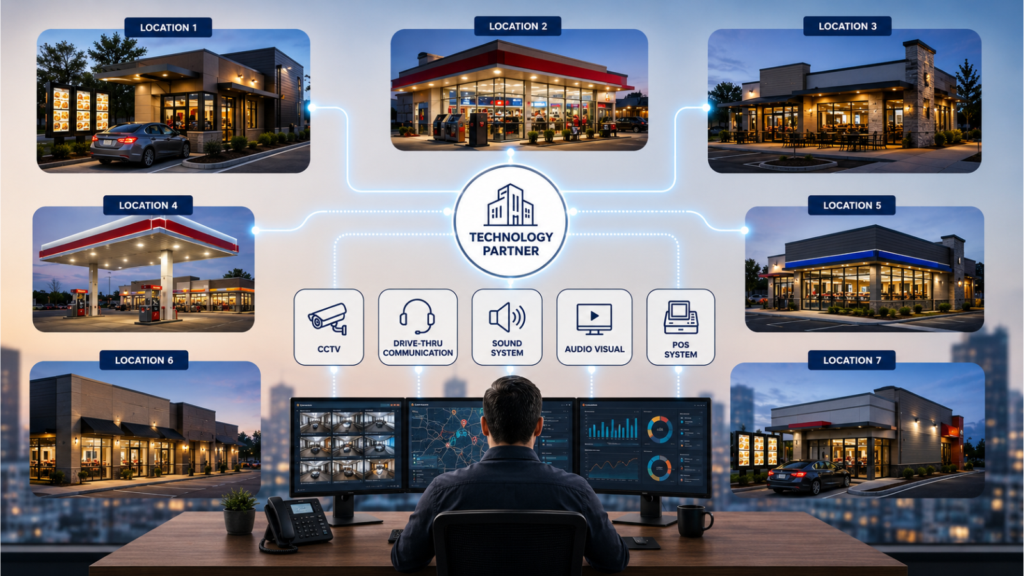
Ask a multi-unit QSR operator how many technology vendors they are managing and the answer is rarely a round number. Drive-thru systems from one provider. Cameras from another. Network from a third. POS from a fourth. Menu boards from a fifth. Each with its own service agreement, its own point of contact, and its own service history at each location.
The overhead that creates is real, and most operators have never actually calculated it. Not just the service call invoices. The management time required to coordinate five vendor relationships across ten or fifteen locations. The performance variance that accumulates when different locations have different equipment generations and different service histories. The repeat service calls that address symptoms without ever fixing the underlying problem because no single vendor has visibility into the full technology stack.
What Technology Vendor Fragmentation Actually Costs
Management time
Every service call at a fragmented operation requires someone at the operator level to identify the right vendor, make contact, explain the problem, coordinate access to the location, follow up when the technician does not show on time, and verify the repair was actually completed. For a multi-unit operator with five vendors across fifteen locations, that coordination load is a meaningful part of someone's job.
The cost is not just the time itself. It is the attention diverted from the things that actually drive revenue. An operations director who spends four hours a week managing technology vendor coordination is an operations director who is not working on staffing, training, or customer experience.
Performance inconsistency
When different locations have different equipment generations, different service histories, and different vendor relationships, performance varies. Your best location and your worst location have the same staffing model. The gap between them is almost always in the technology.
That gap shows up in throughput, in order accuracy, in customer experience, and ultimately in revenue. It is real money, and it is invisible in most reporting because nobody is measuring the technology contribution to the gap. A partner with visibility across all locations can identify it. A fragmented vendor model cannot.
Repeat service calls
A vendor who addresses symptoms rather than root causes creates a cycle where the same problem recurs at the same location every few months. Each call costs money. Each call requires management coordination. And the underlying problem never gets fixed because the vendor does not have visibility into the full technology stack and cannot see what is actually causing the symptom.
The most common version of this pattern: a drive-thru audio problem that keeps getting addressed at the headset level when the real cause is a network configuration issue that affects the full system. A vendor who only handles headsets will fix the headset every time. A partner who can see the full stack will find the network issue once.
What Consolidation Actually Looks Like
Consolidating technology vendors does not mean accepting a worse product in any single category to get the convenience of one invoice. It means finding a partner who can deploy and maintain a consistent, high-quality configuration across every system category you need, at every location you operate.
The operators who manage technology well across multiple locations share a few consistent habits.
They treat technology standardization as an operational priority
Not a procurement decision. Not a cost-cutting exercise. An operational discipline with the same rigor as staffing standards and training programs. Every location runs the same configuration. Every technician who visits knows exactly what is installed. Troubleshooting takes minutes, not hours, because the system is the same everywhere.
They demand proactive maintenance rather than reactive service
A vendor who monitors systems and addresses degradation before it causes failures is worth more than a vendor with a low hourly service rate who only shows up when called. The difference between proactive and reactive maintenance is the difference between a predictable operating cost and an unpredictable one. Operators who have made the switch consistently report that proactive maintenance costs less in total than reactive service, because problems caught early are less expensive than problems caught after they have compounded.
They use performance data across locations to identify system problems before they affect revenue
If location 7 is running 15 seconds slower per car than location 3 with the same staffing model, the right question is not how to motivate the team at location 7. It is what is different about the technology. A partner with visibility across all locations can answer that question. A fragmented vendor model cannot.
The Calculation Worth Making
If you operate five or more locations, it is worth actually calculating what your current technology vendor model costs. Not just the service call invoices. The full picture: management time spent coordinating vendors, repeat call frequency, performance variance between locations, and the revenue gap between your best and worst performers.
Most operators who do this calculation for the first time are surprised by the number. The service calls are visible. The management overhead and the performance variance are not. But they are real, and they compound across every location, every month.
CGS serves multi-unit operators across Georgia, South Carolina, and Ohio. We handle the full technology stack: drive-thru systems, CCTV, commercial WiFi, structured cabling, POS, and digital menu boards. One partner, one point of accountability, consistent execution across every location. If your current technology vendor model is costing you more than you realize, contact us to start with a conversation about what your operation currently looks like and where the gaps are.
Find Out What Your Current Vendor Model Is Actually Costing You
CGS serves multi-unit operators across Georgia, South Carolina, and Ohio with a single partner covering drive-thru systems, CCTV, commercial WiFi, structured cabling, POS, and digital menu boards. One point of accountability, consistent execution across every location. Start with a conversation about what your operation currently looks like and where the gaps are.
Talk to a Technology Partner
About the Author
Written by Grant Wycliff, President of CGS. Grant works with multi-unit QSR and retail operators across Georgia, South Carolina, and Ohio on technology vendor consolidation, standardization, and full-stack managed service. CGS is a McDonald's OTP-approved technology partner and HME-certified installer handling drive-thru systems, CCTV, commercial WiFi, structured cabling, POS, and digital menu boards across multi-location portfolios. Connect with us on LinkedIn.